Five of Swords
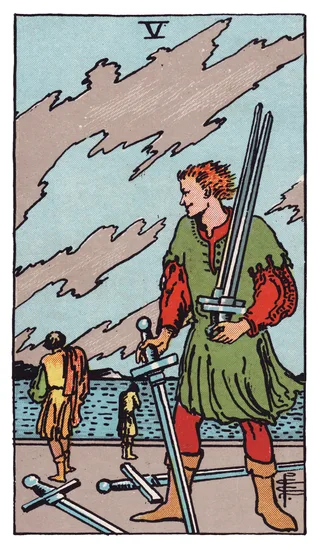
Upright Degradation, destruction, revocation, dishonor
Reversed Degradation, burial, obsequies
He has won and there is nobody left. The winner is gathering up the fallen swords while the losers walk away with their backs turned — this card speaks not of how to win but of what is left after winning. The sky is already torn and the wind has not dropped, a sign that the winner has not been made comfortable either. If you are in a dispute, ask which is larger: what winning gains you, or the person you lose in that spot. And look as well at whether this is a fight that ends by winning or one that ends by stopping.
Air — thought and words, the phase of clashing and sorting. A crisis of shaking and clashing.
Swords came up reversed. Air is tangled in this seat, so there is plenty of thinking and no order to it — while the judgment is postponed, the situation grows larger only inside your head. Written out on paper it is usually smaller than it felt.
Tarot Reading
Three cards for a quick read, or ten in the Celtic Cross for a deep one — with the original 1911 interpretations
Three cards show the current only. The Celtic Cross is a ten-position layout that has served as the standard for a hundred years or so, splitting the reading into the matter, what crosses it, the foundation, the surroundings and where it lands.
Pick a question and the positions change meaning
Card art from the public-domain 1909 Rider-Waite-Smith deck. Meanings condensed from A.E. Waite's 1911 "The Pictorial Key to the Tarot" (public domain).